
Roll a retractable awning in before snow arrives, and clear snow and ice off a stationary awning soon after a storm so it cannot sag or drag the fabric down. Eikelberger Awning & Drapery Co. builds, installs and repairs awnings in Sparks for northern Nevada homes and businesses.
Key points
- NOAA's 1991-2020 normals list 20.9 inches of snow a year at the Reno airport, 21.8 at Minden, 14.0 at Carson City and 4.5 at Fallon.
- Retract a retractable before snow and leave it in until spring weather returns.
- Clear snow and ice off a stationary awning after a storm.
- Washoe County sets ground snow loads by elevation in its design table, and the building department reads the value for each parcel.
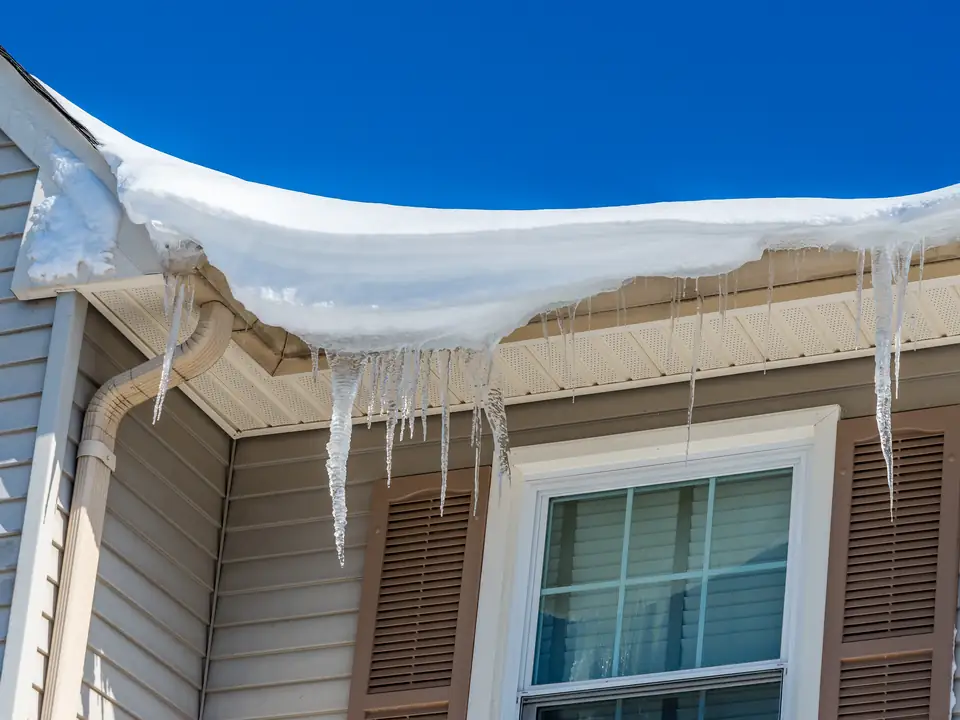
Winter in the Truckee Meadows is shorter and drier than in the Sierra, but it still brings snow, freezing nights and ice. Here is what NOAA's climate normals show for the towns we serve and how to care for each kind of awning through the season.
How Much Snow We Get
NOAA's 1991-2020 U.S. Climate Normals list annual snowfall of 20.9 inches at the Reno airport (Reno Tahoe International), 21.8 inches at Minden, 14.0 inches at Carson City and 4.5 inches at the Fallon Experiment Station. Those are yearly totals averaged over thirty years. The snow arrives in a handful of storms, often followed by clear, cold nights when melting snow refreezes.
That freeze-thaw pattern is what matters for an awning. Snow that melts on a sunny afternoon and freezes at night turns into ice, and ice is heavier and stickier than the snow it came from.
What Snow and Ice Do to an Awning
An awning is designed to shed light rain and shade the sun. Heavy rain, snow or ice sitting in the center of the fabric can make it sag, and snow or ice left in the middle is worse than rain for causing sag. Ice that builds up and hangs over the front edge can drag the awning down. Raindrops or melting snow left on top can freeze into ice.
That is why our standing advice is to retract or remove the awning if you know snow is coming, and otherwise to clear the top right after the storm. For more on weather problems of every kind, see preventing and solving issues with your outdoor awning.
Retractable Awnings in Winter
A retractable awning has the simplest winter answer: close it before the storm and leave it rolled up. A closed awning is out of the weather, and the fabric stays clean and dry. Roll it out again on a mild day if you want sun on the patio, and close it when the sky turns.
A motor makes this easier on cold mornings. We offer Somfy motorization with remotes, so you can close the awning from inside the house. See motorized awnings and shades. Wind matters in spring, and our guide on retractable awnings and Reno wind covers that season.
Stationary and Window Awnings in Winter
A stationary awning stays up all year. After a snowfall, brush the snow gently off the top with a soft broom or brush from a safe position, and do not chip at ice with a hard tool, which can cut the fabric. If ice is hanging off the edge, have the awning looked at before the next storm. Our window and door awnings are built as fixed frames in our Sparks shop for just this reason: they stand through the season and come back to work in the sun.
A low winter sun can still reach a window under an awning, which is a plus when you want the warmth. The Building America Solution Center notes that direct sunlight is likely to get past an awning when the sun is not directly overhead.
Snow Loads for Covered Structures
A larger fixed cover, such as a patio cover, is designed for a ground snow load. Washoe County's Construction Design Requirements page publishes Table 1608.2.1, which lists ground snow load by elevation and Risk Category. For Risk Category II, the table lists 43 pounds per square foot at 4,500 and at 5,000 feet, and the page's footnote says the final roof snow design load shall not be less than 29 psf. The county's table is a starting point for designers, and the building department reads the value for each parcel.
The county's patio cover handout also says structural engineering is strongly recommended for all patio covers and decks, and required when the ground snow load is more than 70 pounds per square foot or the design goes beyond the prescriptive requirements. The building department sets the value for your property, and we check with the building department for each job, and our guide to awning and patio cover permits explains what the county and the City of Reno publish.
A Winter Checklist
A few minutes at the start and end of the season keeps an awning working for years.
- Before the first snow, roll in every retractable and check the fabric and arms.
- After a storm, clear snow from stationary awnings and look at the edge for ice.
- In spring, hose the fabric and brush off debris before you roll it back out.
- If fabric has stretched, torn or frayed, call us for repair or re-covering.
- Covers for outdoor furniture and equipment keep snow off cushions; see patio cushions and equipment covers.
Sources (7)
- Washoe County: washoecounty.gov/building/getting_started/Construction_Design_Requirements.php (checked November 2026)
- Washoe County: washoecounty.gov/building/Files_2020/Decks-and-Patio-Covers-handout-2022.pdf (checked November 2026)
- PNNL / DOE Building America Solution Center: basc.pnnl.gov/resource-guides/window-attachments-solar-control-and-energy-efficiency (checked November 2026)
- NOAA National Centers for Environmental Information: ncei.noaa.gov/data/normals-annualseasonal/1991-2020/access/USW00023185.csv (checked November 2026)
- NOAA National Centers for Environmental Information: ncei.noaa.gov/data/normals-annualseasonal/1991-2020/access/USC00261485.csv (checked November 2026)
- NOAA National Centers for Environmental Information: ncei.noaa.gov/data/normals-annualseasonal/1991-2020/access/USC00265191.csv (checked November 2026)
- NOAA National Centers for Environmental Information: ncei.noaa.gov/data/normals-annualseasonal/1991-2020/access/USC00262780.csv (checked November 2026)