
Studies say yes, an awning that shades a window can cut cooling energy, but the amount varies with the house, the window and the climate, and no study can promise a number for your home. Eikelberger Awning & Drapery designs, makes and installs awnings and solar screens in Reno, Sparks and northern Nevada, and we tell you what the research shows without promising a result.
Key points
- Oak Ridge National Laboratory (2022): awnings left closed April to September can reduce annual HVAC energy use by 15% in a model covering climate zones 1A through 4B, which do not include northern Nevada.
- Building America Solution Center: DOE field studies report summer cooling savings of 15% to 25% from optimized shades.
- PAMA's study: 17 to 72 percent cooling savings depending on the city; not guaranteed for every home.
- None of these are a promise for a particular house.
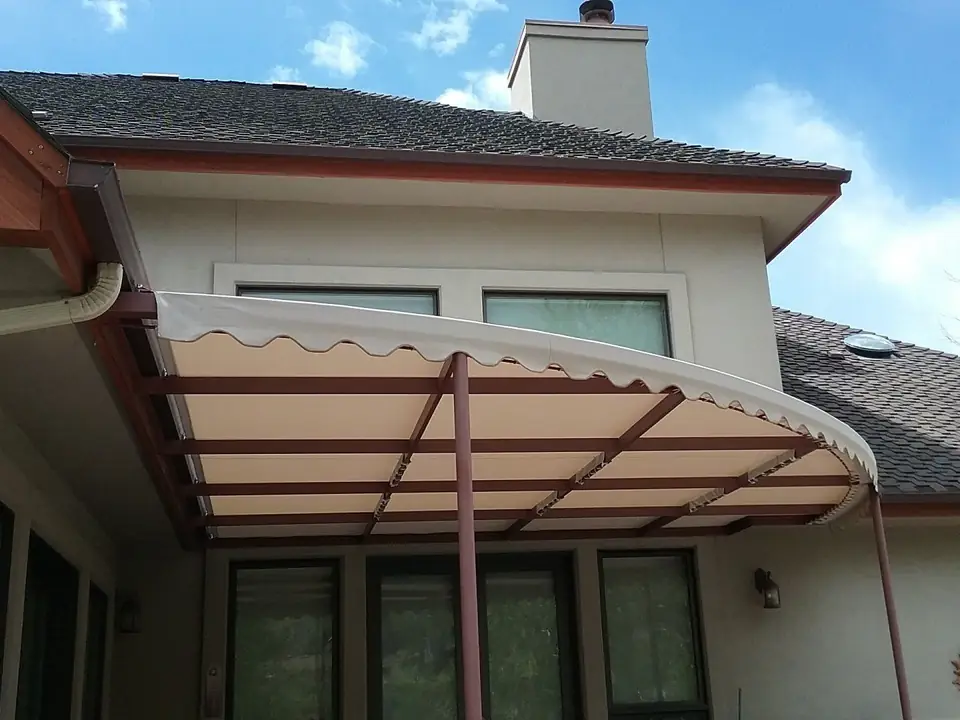
Three sources come up when people ask this question: a national laboratory model, Department of Energy field studies and an awning industry study. Each measures something different, so it helps to read them side by side.
What Did the Oak Ridge Study Find?
Oak Ridge National Laboratory's 2022 report, Energy Performance of Awnings in Residential Buildings, by Mahabir Bhandari, Niraj Kunwar, Anthony Gehl and John Gant, found that "awnings left in the closed position from April to September can reduce annual HVAC energy consumption by 15%." The authors validated a computer model, then used it on U.S. Department of Energy prototype buildings in climate zones 1A through 4B.
Two points matter. It is a model, not a measurement of a real house. And its climate zones, 1A through 4B, do not include northern Nevada, so we treat it as a general result, not a figure for any house here.
What Do the Department of Energy Field Studies Show?
The Building America Solution Center, a Department of Energy resource with content from Pacific Northwest National Laboratory, reports that "DOE field studies have demonstrated whole home summertime cooling savings ranging from 15% to 25%" from the optimized use of high-efficiency shades, interior and exterior. The page, updated July 26, 2023, adds that exterior attachments "block solar heat before it reaches the window."
The same page is honest about limits. Awnings, it says, can be very effective at shading windows while still allowing view, but "direct sunlight is likely to bypass awnings when the sun is not directly overhead." That is the low morning and afternoon sun, and it is why the guide suggests pairing an awning with vertical shading such as roller shades or blinds.
What Is the Industry Study, and How Far Does It Go?
The Professional Awning Manufacturers Association commissioned its Awning Energy Study II, run by Joe Huang of White Box Technologies, covering 50 U.S. cities. Specialty Fabrics Review reported that average cooling energy savings with awnings "can range from 17-72 percent in a house with equally distributed windows during a typical year depending on the city." The article says the results come from one specific model and are not guaranteed for every home.
That wide range tells you something real: the savings depend on where the house is, how many windows face the sun and how the awning is built. Read it as an industry association's study, not an independent test.
| Source | What it measured | Result | Read it as |
|---|---|---|---|
| Oak Ridge National Laboratory, 2022 | Model of awnings closed April to September, climate zones 1A to 4B (not northern Nevada) | 15% lower annual HVAC energy | A model, not a house |
| Building America Solution Center, 2023 | DOE field studies of optimized shades, interior and exterior | 15% to 25% whole-home summertime cooling savings | A range for shade systems in general |
| PAMA Awning Energy Study II, 2012 | Cooling savings in a model house across 50 cities | 17 to 72 percent, depending on the city | An industry study; not guaranteed for every home |
What Decides How Much an Awning Helps?
That is why we look at the actual wall at the estimate, rather than quote a percentage.
- Which way the window faces. South and west glass takes the most sun.
- How far the awning projects and how high it sits over the glass, which controls how much summer sun it blocks.
- Whether it is open when the sun is on the window. A retractable that stays rolled in does nothing.
- Glass area. A wall of glass has more to gain than a small window.
- What else shades the window: trees, a porch roof or exterior solar screens for the low sun that gets under an awning.
What Eikelberger Does
We design and build the pieces: window and door awnings, retractable awnings and exterior solar screens, with Somfy motors and sensors so a retractable can open and close without you thinking about it. We accurately measure all projects to be custom-made for precision and functionality. For a deeper look at northern Nevada's sun, see our sun, heat, wind and snow data.
Sources (3)
- Oak Ridge National Laboratory: ornl.gov/publication/energy-performance-awnings-residential-buildings (checked November 2026)
- PNNL / DOE Building America Solution Center: basc.pnnl.gov/resource-guides/window-attachments-solar-control-and-energy-efficiency (checked November 2026)
- Specialty Fabrics Review: specialtyfabricsreview.com/2012/08/01/awnings-provide-cool-solutions-for-homeowners/ (checked November 2026)