A stationary awning stays up all year on a fixed frame and suits windows, doors and spots that want shade every day, while a retractable awning rolls out over a patio or deck when you want shade and back in when you do not. Eikelberger Awning & Drapery in Sparks offers and installs both, and many northern Nevada homes end up with a mix.
Key points
- Stationary: always on, no daily handling, the classic choice for windows and doors.
- Retractable: shade on demand for patios and decks; roll it in for wind, heavy rain and snow.
- The Reno airport averages 8.1 to 8.2 mph wind in April and May versus 6.1 mph for the year (WRCC).
- Reno averages 20.9 inches of snow a year (NOAA 1991-2020), so a fixed frame has to live with winter.
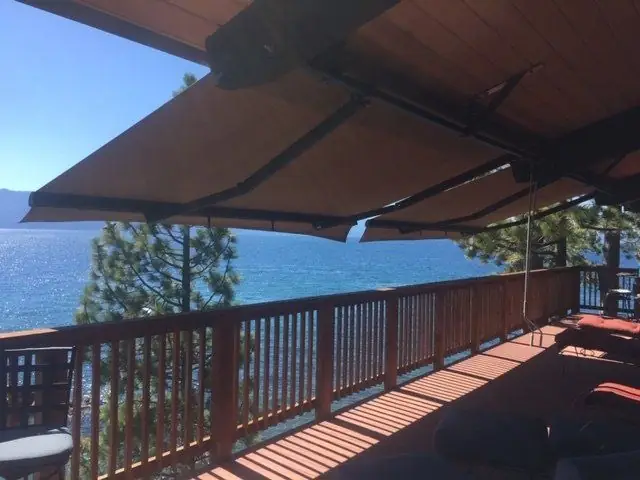
We offer stationary and retractable systems for both windows and patios. The right pick depends on the spot, how you use it and the weather it faces.
The Short Answer: Where Each One Fits
Put a stationary awning where you want shade every sunny day and nobody wants to think about it: over a south or west window, a front door, a side entry or a small porch. Put a retractable where the space changes use: a deck you sit on in the evening, a patio that should be sunny in spring, a slider you want shaded at 4 pm and open to the stars at 9.
The deciding questions: how big the area is, how often it is used, how exposed it is to wind, and whether you want a crank or a motor.
Side by Side
| Question | Stationary awning | Retractable awning |
|---|---|---|
| Typical spots | Windows, doors, entries, small porches | Patios, decks, sliders, outdoor dining |
| Frame | Fixed frame, metal or fabric-covered | Folding arms on a wall-mounted bar, often with a hood |
| Daily handling | None | Crank or Somfy motor; roll in when not in use |
| Wind | Built to stay up; check after a storm | Retract when big winds are forecast |
| Snow and ice | Brush off heavy snow; frame stays out | Retract before snow; fabric rests out of the weather |
| Winter sun | Lets low winter sun in under a window awning | Roll in to let all of it in |
| Styles | Dome, scalloped, straight valance, metal | Frame styles vary by system |
Not sure which row matters most for your house? Ask about it at the free estimate.
Wind: Why Retractables Roll In
Spring is the windiest stretch in the Truckee Meadows. The Western Regional Climate Center's table for the Reno airport (ASOS, 1996-2006) shows an average wind speed of 6.1 mph for the year, 4.4 in January, 8.1 in April, 8.2 in May and 8.0 in June; Fallon NAS averages 6.9 for the year and 8.6 in April. These are averages, not gust figures.
An awning catches wind a little like a kite. That is why our standing advice for retractables is to watch the forecast and retract the awning if big winds are predicted, and to check every awning on the house after a storm. Read more in retractable awnings and Reno wind.
Snow and Winter
The NOAA 1991-2020 normals average 20.9 inches of snowfall a year at the Reno airport, 21.8 inches at Minden, 14.0 at Carson City and 4.5 at the Fallon Experiment Station. Snow that sits in the middle of fabric can make it sag, and ice hanging off the edge can drag it down.
A retractable has the easy answer: roll it in before snow and let it sit out of the weather until spring. A stationary awning stays out, so brush heavy snow off the top after a storm. For covered structures, Washoe County's design table lists a ground snow load of 43 pounds per square foot at 4,500 and 5,000 feet, rising with elevation west of old Highway 395; the building department reads the value for each parcel. See awnings in snow and winter.
Sun and the Seasons
A fixed awning over a window works with the seasons: high summer sun is blocked, and the low winter sun can still reach under it. The Building America Solution Center notes that awnings "can be very effective at shading windows while still allowing view."
A retractable gives you that choice with more control, and exterior solar screens handle the low west sun that slips under any awning.
Care, Permits and Fabric
- Care: both need fabric brushed and hosed off; retractables also need clean, lightly lubricated arm joints and an occasional look at the motor or crank.
- Permits: Washoe County lists window awnings on houses that project no more than 54 inches from the wall (with its other conditions) as exempt work in unincorporated areas; larger awnings and patio covers usually need a permit. We check with your city or county building department before we build.
- HOAs: where there is a registered architectural committee, its approval comes before plans go to the county.
- Fabric: both types use the same brand-name fabrics, including Sunbrella, Tempotest and Sattler, in hundreds of colors and fabric patterns.
What Eikelberger Does
We offer both kinds: window and door awnings, metal awnings and canvas awnings for stationary work, and retractable awnings with manual or Somfy motorized operation. We accurately measure all projects to be custom-made for precision and functionality, and we install them to the exacting specifications that our discriminating customers demand.
Sources (9)
- Western Regional Climate Center: wrcc.dri.edu/Climate/comp_table_show.php?stype=wind_speed_avg (checked November 2026)
- PNNL / DOE Building America Solution Center: basc.pnnl.gov/resource-guides/window-attachments-solar-control-and-energy-efficiency (checked November 2026)
- Washoe County: washoecounty.gov/building/getting_started/Construction_Design_Requirements.php (checked November 2026)
- Washoe County: washoecounty.gov/building/Files/Files/Handouts/Work%20Exempted%20from%20Permits-MH%20final (checked November 2026)
- Washoe County: washoecounty.gov/building/Files_2020/Decks-and-Patio-Covers-handout-2022.pdf (checked November 2026)
- NOAA National Centers for Environmental Information: ncei.noaa.gov/data/normals-annualseasonal/1991-2020/access/USW00023185.csv (checked November 2026)
- NOAA National Centers for Environmental Information: ncei.noaa.gov/data/normals-annualseasonal/1991-2020/access/USC00261485.csv (checked November 2026)
- NOAA National Centers for Environmental Information: ncei.noaa.gov/data/normals-annualseasonal/1991-2020/access/USC00265191.csv (checked November 2026)
- NOAA National Centers for Environmental Information: ncei.noaa.gov/data/normals-annualseasonal/1991-2020/access/USC00262780.csv (checked November 2026)